






In a presentation to the American Academy of Ophthalmic Professionals (AAOP) at the American Academy of Ophthalmology 2026 meeting in New Orleans, Richard J. Kolker, MD, Andrew F. Kolker, MD, Jane T. Shuman, MSM, COT, COE, OCS, and Amy Jost, MEd, COMT, CCRC, discussed the most often confusing steps of the Jackson cross cylinder for determining cylinder axis and power.
"The Jackson cross cylinder should be loved, not feared,” said Dr. Richard Kolker. "It is amazing that this little lens can find both the axis and the power of the astigmatism correction."
Shuman noted that the most common mistake that she has seen technicians make is not using the Jackson cross cylinder and instead turning the dials manually. “In many practices, it is common to be shown how to refract by several people,” she explained. “There is no one right way, so the learner gets confused and morphs the various techniques they have been shown into their own method.”
She also said the axis-refinement portion of the Jackson cross cylinder technique can be particularly confusing for technicians. “We use the phrase, ‘chasing the white or red dot,’ depending on plus or minus cylinder respectively,” she said. “Many do not realize it means that the arrow beneath the Jackson cross cylinder moves towards the appropriate dot (Figure 1).”
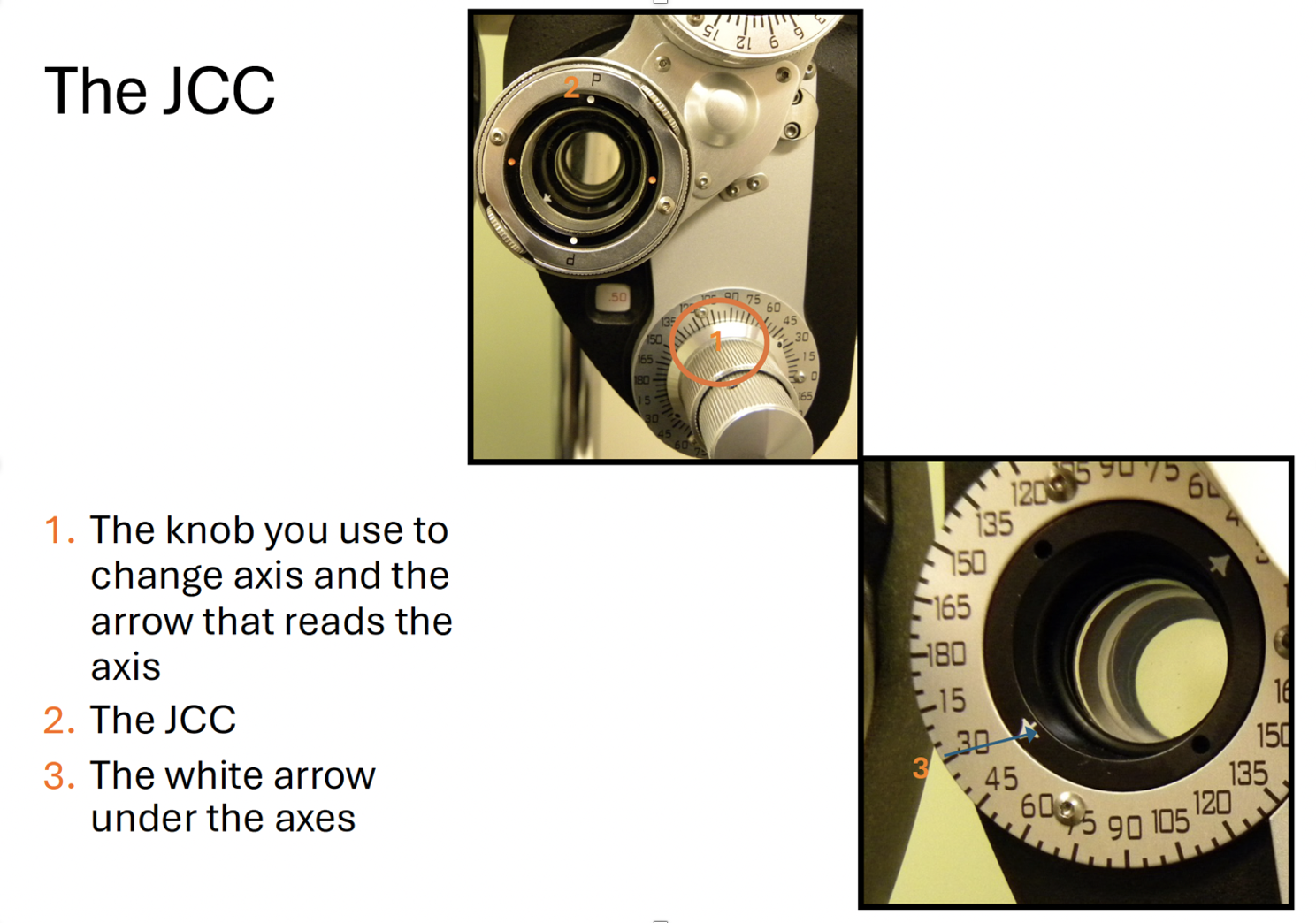
Shuman walked participants through the correct technique for refining cylinder axis with the Jackson cross cylinder. “Begin with the cylinder axis in their glasses, or the autorefractor or retinoscopy. Offer the patient 3 choices when flipping the Jackson cross cylinder: one, two, or the same. If the patient has a preference, turn the axis knob 10° towards that choice (chase the dot) and repeat. If they want to go back, turn the axis knob 5° in that direction. Continue if necessary. The end point is when the patient indicates they appear to be the same.”
She also emphasized to participants the importance of understanding how the Jackson cross cylinder is constructed. “One side is +0.25 power, and the other is -0.25 power. The axes are 90 degrees apart (Figure 2).” This is important, she said, because with this understanding, technicians see that the choices offered are exaggerations of axis change and an additional or reduction of 0.25 cylinder power.
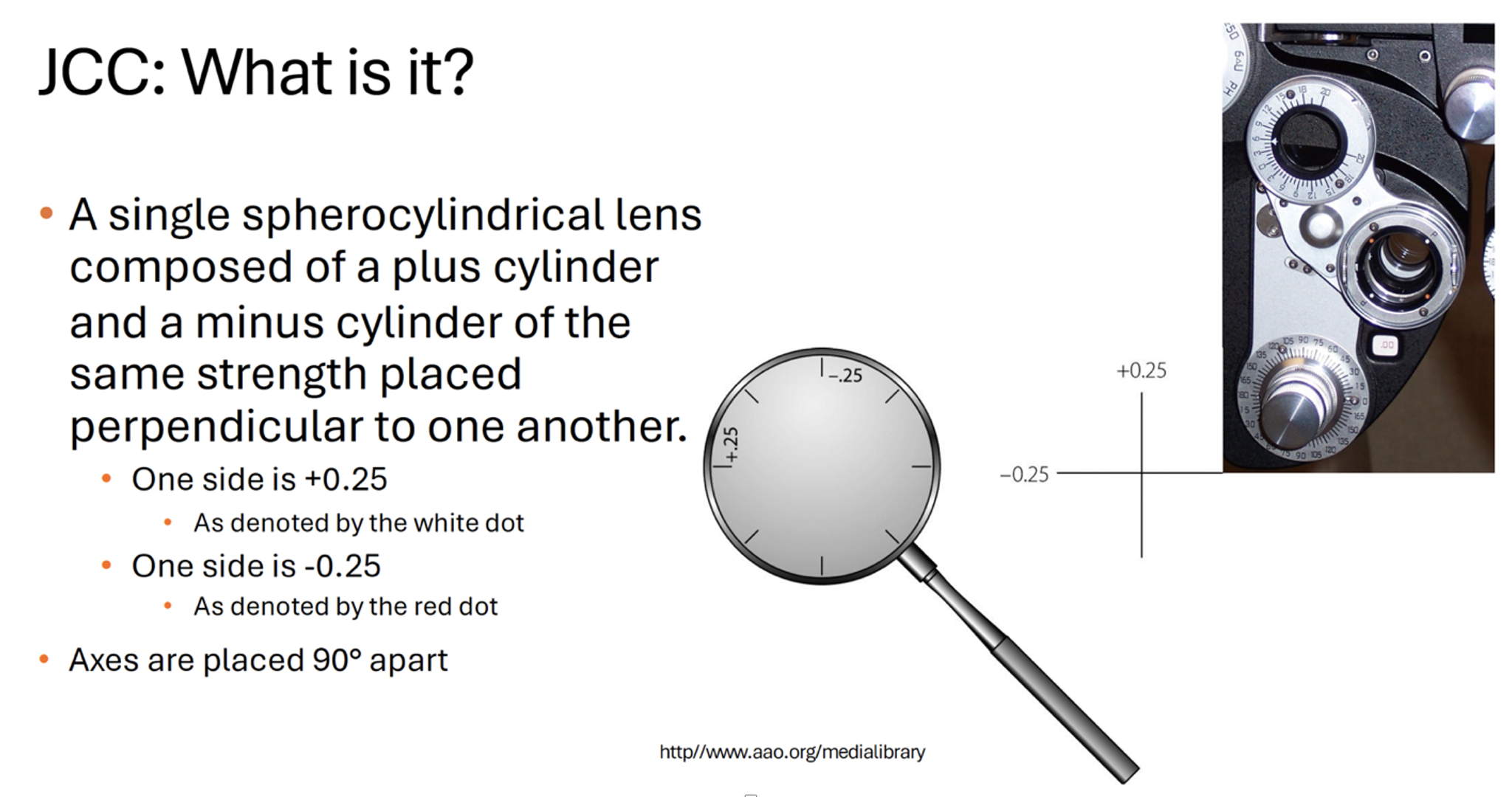
“I joke that the Jackson cross cylinder is the part of refraction techs love to hate, and they agree. But once they understand how it works, and what it means to chase the dot, using it becomes second nature,” she explained.
More Tips for Using the Jackson Cross Cylinder
According to Dr. Richard Kolker, “Only 2 easy rules are needed to find cylinder axis and only 2 easy rules to find cylinder power.” For plus cylinder, he said, the 2 rules are as follows:
-
For axis: 1) dots straddle the axis, and 2) follow the white;
-
For power: 1) dots are on axis, and 2) white add, red subtract (this rule is opposite for minus cylinder).
“Only turn the axis and power knobs after Dr. Jackson (ie, the Jackson cross cylinder) tells us what to do!" said Dr. Kolker. "When refining axis, pick the arrow easiest to see and only look at the red and white dots surrounding it. Ignore the other arrow and its dots to avoid a mistake."
Technicians and Ophthalmologists Working Together
Shuman said technicians and ophthalmologists can work together to ensure accurate and consistent refraction when using the Jackson cross cylinder to refine cylinder axis and power.
“When training technicians to refract, a senior technician should recheck it and discuss any changes needed,” she said. “The ophthalmologists should also provide feedback when they make changes and build confidence by indicating a difficult refraction was done well.”
Emphasizing the importance of feedback, Dr. Richard Kolker said that over time the ophthalmologist, through feedback, develops confidence in the ability of the technician to perform an excellent refraction. “When that occurs, it is very beneficial for the ophthalmologist and the patient," he explained.
Dr. Andrew Kolker added, “I've worked with many amazing technicians, and I rely on them heavily. They set the tone and flow of the clinic, and a great tech is one of the biggest assets a practice can have. Feedback is essential, but it should always be a two-way conversation. We're partners in every patient's care.” OM.