




As director of business development for a 44-year-old practice serving East Texas, it is my responsibility to make sure our longevity does not become a proxy for complacency. Luckily, the practice has never been content to rest on what worked in decades past, and forward-facing technology has been part of our DNA from day 1. Keeping us at the forefront, however, requires continually raising the bar on what we’re willing to invest in while also understanding that technology adoption only works if the whole organization is invested. For us, that means being and staying at the cutting edge of innovation.
A Culture of Being First
Heaton Eye views early adoption as an organizational value. We were the first practice in East Texas to offer LASIK and to implant the earliest premium intraocular lenses (IOLs), including the first trifocal IOLs and Light Adjustable Lens (LAL; RxSight). We led the market in conductive keratoplasty volume when the procedure was at its peak. Most recently, on the glaucoma side, we were the first in our region to promote interventional glaucoma procedures like sustained-release therapy, iDose, and minimally invasive glaucoma surgery (MIGS) at a time when most of our competitors were still prescribing intraocular pressure-lowering drops as a first-line treatment.
That said, being first doesn’t mean being cavalier. Over the years, we’ve passed on technologies that we felt wouldn’t serve our market, advance outcomes, or enhance the patient experience.
In the 12 years that I have been with Heaton Eye, the practice has evolved from a 6-surgeon group working out of a single operating room to a multispecialty practice with 4 operating rooms, and 20 providers including 2 pediatric ophthalmologists, the only oculoplastic surgeon in East Texas, and a suite of technologies that we believe help us deliver the best outcomes for our patients. However, what I share here is less about a single piece of equipment and more about the philosophy and practical mechanics of building and sustaining a premium practice in a community market.
Growing Pains and Practice Growth
Several years ago, Heaton Eye faced major growing pains. We considered adding a few new technologies, including a femtosecond laser for cataract surgery, but with only 1 operating room, our tolerance for workflow disruption was essentially zero. We researched several platforms. The time penalty per case, however, made adoption impractical.
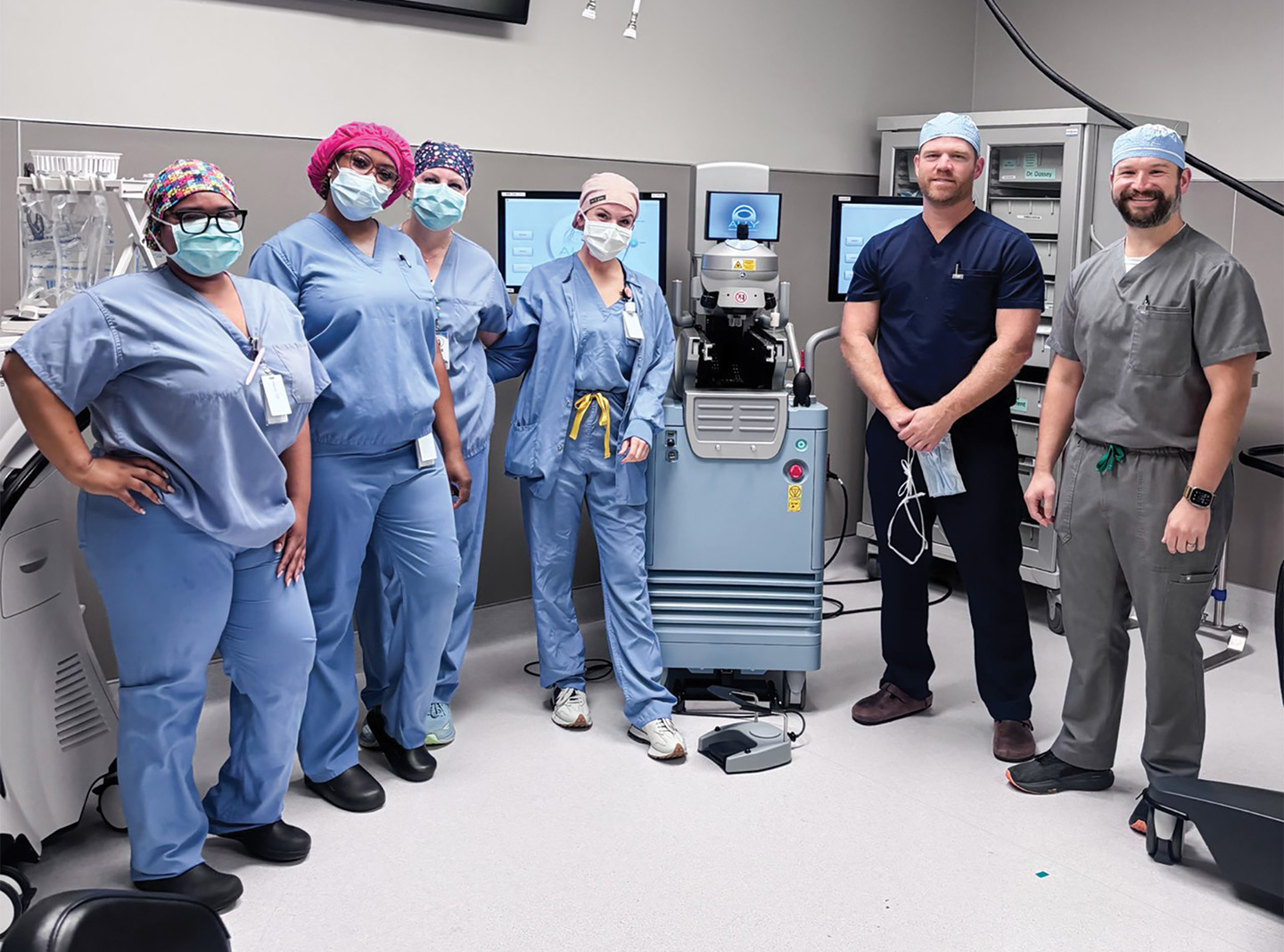
Once we moved to a significantly larger facility, our workflow flexibility improved, and we revisited the idea of femtosecond-assisted cataract surgery with a fresh perspective. Within 2 months, we developed a good rhythm, and procedure timing and team alignment converged to improve not only our efficiency, but also the patient experience (Figure 1). With its integrated robotic assistance and real-time anterior segment imaging, the Ally Robotic Cataract Laser System (Lensar) provides precise, real-time ocular measurements, addressing some concerns that caused us to pass on earlier platforms.
The macro environment for cataract surgery also factored into our decision to adopt laser-assisted cataract surgery with a robotic system. Reimbursement cuts are pressuring traditional surgical economics. The ability to offer differentiated, premium packages with genuine clinical rationale is important for both revenue and patient value. The laser is a clinical upgrade that we can stand behind.
Technology Integration and Staff Buy-In
Laser-assisted surgery is integrated into our premium offerings to keep the decision pathway simple. In our practice, we structure cataract surgery packages in 4 tiers to give patients a clear, manageable decision framework without overwhelming them. Option 1 is standard monofocal surgery, which does not include laser-assisted surgery. Options 2, 3, and 4 cover astigmatism management with a toric lens or a limbal-relaxing incision; multifocal or extended-depth-of-focus technology; or the LAL, respectively. These options automatically include laser-assisted surgery as part of the package. We don’t offer the laser a la carte.
On the surgical planning side, Veracity and Callisto (both by Zeiss) have a tangible effect on surgeon confidence, particularly for complex cases. I recently watched a newer surgeon place a toric lens with precision guidance in a post-LASIK cataract case. The combination of surgical guidance with a laser-assisted technique didn’t just support the surgery, it supported the surgeon, too.
Surgeon confidence extends beyond the operating room. When physicians feel good about their practice’s offerings, they communicate confidently to patients. Additionally, the staff picks up on these signals and reflects the same attitude back to patients. Surgeon buy-in also supports the education cascade reaching every corner of the practice. Our surgery counselors now understand robotic cataract surgery technology almost as well as the surgeons do. They field complex patient questions, explain the value of an upgrade, and help set expectations before a patient ever gets to the operating room. I like to tell counselors they need to be able to explain a technology to a 10-year-old. If they can do that, they will understand the technology well enough to answer any question a patient asks.
Even front desk and call center staff need basic literacy. When a patient calls and asks about the robotic laser they saw on a billboard, the person who answers the phone can’t sound like they’ve never heard of it. Even a moment of hesitation may cost us their trust. I developed a brief set of talking points for nonclinical staff to help them handle a passing question confidently and transfer a call appropriately when patients need more detail.
Lastly, referring physicians must understand our offerings and how they benefit their patients. Lensar provided talking points calibrated specifically to the optometric perspective, articulating the clinical rationale and patient benefit in a way that resonated with a referral audience rather than a consumer one.
Communicating Premium Technology to a Community Market
In East Texas, there is also a hospital system and several private-equity-backed groups to compete with. Exclusivity in our market is a meaningful differentiator. Currently, we are the only practice offering robotic laser-assisted cataract surgery. We support that message across billboards, streaming video, TV, search engine optimization, and social media. That said, our most powerful marketing channel is word of mouth. In a close-knit community, every excellent surgical outcome ripples outward in ways that no paid placement can replicate. We’ve seen early evidence of a 2% increase in our premium adoption rate since introducing laser-assisted surgery.
Heaton Eye is only 5 months into our laser-assisted cataract surgery program, which means we’re still in the early days of understanding its full impact. Around 9 months, I plan to perform a rigorous review of its adoption data, enhancement rates, and conversion trends.
Conclusion
Forty-four years in, Heaton Eye is still learning, but our foundation hasn't changed. We believe in the technologies we offer, we prepare our team for success, and we let the outcomes do the rest. OASC